A Conversation with Steve Komarnyckyj
In July 2026, Blue Rivers editor Joshua Wait spoke with poet, translator, and educator Steve Komarnyckyj. They discussed the experiences that shaped his writing, the influence of Ukrainian literature, and the art of translation. The conversation also explored the enduring impact of Ukrainian literature in the face of war and cultural erasure.
Joshua Wait: What were some of your formative experiences as a writer? When did you have a sense that you wanted to be a writer or a poet?
Steve Komarnyckyj: I always wanted to be a poet. As a child, I was relatively late learning to speak and I was fascinated by the incantatory qualities of language and was always improvising rhymes. I began to encounter poets and read voraciously ahead of my chronological age. This is partly because I was dyspraxic and my Ukrainian father taught me to read.
Dyspraxia is a kind of developmental disorder. I struggle to tie my shoelaces, for example, and my mind is always fizzing, popping, exploding with ideas, images, and words. Poetry gives me a sense of coherence and structure which carries me through my internal chaos and I began to write poems almost unconsciously from an early age.
My Ukrainian father also taught me how to speak and I began to read T.S. Eliot perhaps when I was eleven or twelve. I did not understand it of course but I was mesmerised by the rhythm of the language, the incantatory quality. Poetry for me is almost like a spell, as Charles Causley believed, it is like an incantation that you utter against the darkness and against the absence.
Words and chains of thought would develop and coalesce in my mind when I was a child. What drew me to poetry was that it gave me a kind of coherent identity. I said quite early on “I want to be a poet” and now I am a poet.
“Poetry for me is almost like a spell. It is like an incantation that you utter against the darkness and against the absence.”
—Steve Komarncykyj
Much of the material I wrote early on was rubbish. I was focused on my own subjectivity. There are very few poets who can inhabit their own psyche in their work. Sylvia Plath is a fascinating example of that kind of poet. Her work had a whole system of magical symbols, her psyche projected onto the cosmos. There is a kind of ritualised death and resurrection in The Bell Jar and “Lady Lazarus,” with real experience being drawn subjective, mythological world.
My own mythological world could not speak to anyone. It is only as I began to break free of it, to interact and engage and write like other poets, that I began to find a way to poetry. Eliot calls it an objective correlative—a thing outside myself around which my feelings and sensations and mental turmoil could cohere. And at the same time, being Ukrainian is like being from a country that even now largely does not exist in English discourse. I might as well have been from Narnia.
The poet Philip Gross wrote a collection called The Son of the Duke of Nowhere. His father was Estonian and the title spoke to me of that invisible legacy.
There was a huge heritage from Ukraine but its existence was denied in the history I learned at school and in popular culture. My father probably had what is called post-traumatic stress disorder so could not, at least in my youth, really counterbalance a very Russocentric cultural environment. There was the Ukrainian club and its shelves of fascinating Ukrainian books. But while Ukraine was very present and my father was a monumental figure to me, in English textbooks, university textbooks, it was invisible. In popular discourse, Ukraine was either invisible or stigmatised and that remains largely true. It’s the country where the anti-Semites come from, the fascists, and the Nazis for many people. And it was only later, perhaps in the last ten years, that I really came to understand that stigmatisation.
Russia is locked into a pattern of repeated genocides in Ukraine, and that really requires Russia to stigmatise Ukraine and Ukrainian identity all the time. So, according to their propaganda, if they raze cities to the ground and massacre people, it’s because we’re bad and we deserve it.
I do identify as Ukrainian. When I first started going to Europe, I encountered a lot of people who would hear my surname Komarnycky and ask, “Where’s that from?” and I’d say, “Ukraine.” And then they’d explain to me what Ukrainian was using Russian narratives.
The poem “Tickling” is about the Circassians. It’s probably not an event that you understand or know about. As Russia expanded into the Caucasus, over a century they killed a vast number of people, over a million.
The Russians told their own version of the story and they used Ukrainians to settle the area as kind of quasi-Russians, if you will.
The poem depicts the predatory impulses that drive imperialism and depicts Ukrainians being instrumentalised by Russians to destroy this place called Circassia. And Circassians now, their descendants are being used by Russians in Ukraine to attack Ukraine although many also fight for Ukraine against the empire. So that poem is really about the roots of imperialist violence being a very basic human impulse, like catching fish.
JW: You’ve written material other than poetry and you’ve done some teaching as well.
SK: I teach writing poetry online at the Poetry School which is based in London. One of the first courses I taught was about how to write English poetry, using translated poetry, often my own translations as examples and starting points. I would present a Ukrainian poem, and then I would present a topic or writing exercise based around that poem.
For example, I placed the Ukrainian poet Vasyl Stus, who wrote a poem called “Winter Trees,” alongside Sylvia Plath, who also wrote a poem called “Winter Trees.” I can’t remember the themes exactly, but it was about using the poems as a starting point for people’s own writing.
I would present the topics and then people would send their work to me. I would critique the poems and then make suggestions as to how the writers could develop them, but not in a prescriptive way. I wasn’t saying, “I am the master and you’re my pupil.” It was more like, have you considered this idea? It is a kind of peer-to-peer teaching.
I also translated some poems for them in a series called Stanzas for Ukraine. I’m not completely satisfied with all the work that I did for that project, because it was very hurried and I was working during a very emotionally pressured time. However, most of that project is extremely powerful and is being cited.
Although I’m not directly affected by the genocide war Russia is waging on Ukraine, it’s like someone’s trying to wipe out part of me. If I see a Ukrainian flag, I have to keep looking at it to reassure myself that Ukraine still exists.
I have a collection of books by Lesya Ukrainka. It’s a Soviet edition that was itself censored. And I saw footage from Mariupol of that same edition being burned. It’s a very weird feeling. I wrote Stanzas for Ukraine under a great deal of pressure, but there are some elements that I’m proud of.
JW: How long have you been teaching the writing of poetry?
SK: Not that long. I started teaching at the Poetry School in 2022. The first course coincided with the beginning of the war. The course had about ten or twelve students and, somewhat ironically, was focused on using Ukrainian literature and translation as the basis of inspiration.
If you think about it, translations have always been an important part of poetry. T.S. Eliot imported French symbolism into English language poetry. Imagism, if you will, is the import of certain Japanese methods into English language poetry. Ezra Pound’s lines “The apparition of these faces in the Metro; / Petals on a wet black bough,” are the import of the Japanese concept of just looking and seeing and recording without comment. And Eliot’s twisting and twisting—the lilac stalks. He’s using the ideas of French poetry and symbolism. The English Romantics used Greek and Roman models, for example, the role of Hyperion.
So translation has always been an important part of poetry. But my approach was to use Ukrainian poets, poets who people were not familiar with. I think people found it quite a revelation.
“The very act of writing in Ukrainian is political.”
—Steve Komarncykyj
JW: What can authors working in other languages learn from Ukrainian poets?
SK: There is an article by Rory Finnin at the Huffington Post called “The Rebels and Risk Takers of Ukrainian Literature.” He’s a professor of Ukrainian Studies at the University of Cambridge. He’s originally from Chicago and he’s Irish-American.
Ukrainian was banned and that meant that the very act of writing in Ukrainian was a political act. It was banned from all spheres of public life. The great Ukrainian novel of the 19th century had to be published in Geneva and not in Ukraine itself. That level of risk tended to attract the mavericks, the oddballs, the quirky people.
One of the greatest Ukrainian writers is Lesya Ukrainka. Her real name was Larysa Kosach, but I always think of her as Lesya Ukrainka. Ukrainka simply means Ukrainian woman. She wrote a whole series of plays which are of Shakespearean quality, but they focus on female characters. She deals with and has reworked the Homeric legacy in her own fashion, recasting it as a tale of empowered womanhood in her play Cassandra.
Taras Shevchenko was originally a serf who wrote poetry. He’s perhaps the only national European poet who has ever been owned by another human being. He had to have his freedom purchased. His owner saw his potential and he was apprenticed to the artist Karl Bryullov in Saint Petersburg. One day according to legend he painted a picture of a Russian colonel, which the colonel didn’t like and so he didn’t pay him. Shevchenko sold the painting to a barber, having painted it so it looked as if the colonel was lathered up to be shaved. It was used an advert for the barber’s shaving services. The colonel was furious when he saw the modified painting. He wanted to buy Shevchenko from his owner so that he could flog him mercilessly. Shevchenko’s friends raffled a painting by Karl Bryullov and bought his freedom. But he was only free very briefly. One of his poems landed him in trouble because it had some unflattering lines about the Tsar’s wife and he was sent into exile. His poetry was very much written in the gorgeous language of the Ukrainian peasantry but also had powerful, confessional work, and beautiful lyricism. If you want to know about the Russian empire, you can only really learn what it was like at the bottom.
Finally, there are poets like Pavlo Tychyna. I translated his book Clarinets of the Sun (1918) into English and published it along with a selection of his work with Poetry Salzburg under the title The Raspberry’s Eyelash (2011). There’s a kind of ecstatic engagement with nature and the landscape in his work. The poetry was groundbreaking because it had to be. There was no state-sponsored and no publishing-house tradition for Ukrainian poetry. They were writing in a vacuum. They had the legacy of the medieval literature, but it was appropriated by Russia. They’d been colonised for centuries and the language was suppressed under a series of edicts. It’s worth noting that the first Ukrainian language books, which would have been called Rusyn or Ruthenian language, were burned across Russia in the 1620s. The oppression has been going on for that long.
Ukrainians had no tradition of a formal state literature. They drew very much on folk motifs, like many other European writers of that period. But the very act of writing in Ukrainian is political. And it resulted in a lot of work that was highly original and highly unusual.
Some of the bizarreness of Ukrainian literature has been imported into Russian by authors such as Nikolai Gogol. Well, he’s actually Ukrainian and Mykola Hohol. His early stories draw heavily on Ukrainian folklore. And if you looked at a Russian edition of the early stories, you would see that they had a glossary in the back because he imported a large number of Ukrainian words into Russian.
And even stories that seem Russian on the surface, like “The Nose,” retain a bizarre quality that many trace to Gogol’s Ukrainian background. His novella Taras Bulba first appeared in 1835. In that original version, the Muscovites, the Russians, were portrayed as the enemy. And that would never do. Gogol substantially revised the work in 1842. The second version presents Russian identity and Orthodox patriotism in a more positive light. For more than a century, nearly all English translations were based on the censored version, in which the Russians are no longer the bad guys.
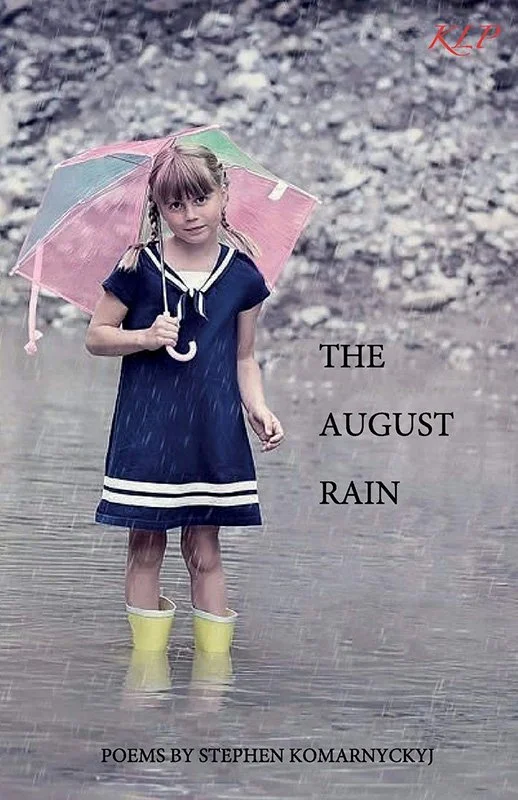
The August Rain, by PEN award winning poet and literary translator Steve Komarnyckyj, “is a book through which memory and its voices lap like waves. Whether it be in his own luminous writing, or through his translations and versions of others, Komarnyckyj communicates a quiet fire that is often ‘stringent as redemption’.” Sean Street, Poet and BBC Broadcaster
“Drawing force both from an English visionary tradition that leads right back to Caedmon and the fevered restlessness of some Slavic poetries, Stephen Komarnyckyj’s is a serious poetry of life’s elemental mysteries and sorrows.” Vivek Narayanan, Poet
JW: The imagery in your poetry is so vivid. I think of the lines “in peat stained water / That was the gold orange of a delicate tea” from your poem “Tickling” and the lines “float up, drop and serve yourself like a tennis ball” from your poem “Out of the Belfry.” They’re beautifully written. They seem to be true to the experience without a need to show virtuosity. Where does your inspiration for imagery come from? And how much do you stretch for a unique image, and when do you show restraint?
SK: The first poets that I admired were the English romantics. I would read Shelley as a teenager and find myself drawn into and mesmerised by the rhythm. I would rock to and fro as I read and be carried away by the poetry. Keats, too. Particularly the Keats of “Ode to a Nightingale” or “Ode on a Grecian Urn.” And Keats said that you must load every rift with ore.
When I began writing, I wanted to ensure that every image and every line had some kind of visual or tactile element. I wanted the poems really to make people sense something—to smell, touch, and feel like they were in the cosmos created by the poem.
I was also influenced by Heaney, whose poetry has a tactile quality. If you look at “Death of a Naturalist,” he describes frogs as “Poised like mud grenades, their blunt heads farting.” He’s obviously an Irish poet, but Irish poets, unfortunately in some respects, write primarily in English, and he draws heavily on the English language tradition. He loaded every poem with visual and tactile imagery and I was very influenced by his work.
I wrote the poem “Tickling” after reading some Paul Muldoon, another Irish poet. He’s like Heaney, but more abstract, quirky, and playful. Sometimes his poems disappear into abstraction. Heaney’s always rooted in the real world, the here and now. Muldoon sometimes enters a magic realist world.
I was very influenced by those poems, by those poets, by their ability to make you think, feel, and see things.
I think there are two ways of writing. Sometimes you write almost unconsciously. The rhythm comes to you, the words come to you and it’s almost like someone else is writing the poem through you. And then there are other times when you have to labour away for a while before you have that moment of liberation and you might write a few lines and then you get stuck again.
Coleridge supposedly was drafting Kubla Khan in his mind when a man from Porlock came round on business and interrupted him. After the man left, Coleridge was only able to remember a few fragments, which became the poem we have today. Sometimes you end up like Coleridge: you get stuck, and what you remember ends up being your poem.
Sometimes I write unconsciously is what I’m trying to say in a very elaborate way. And then sometimes I have to labour. I look to other poets for inspiration. I might read some Auden, for example, or some Larkin. And that might trigger my own poetry.
Or I might think about a memory. Recently, I’ve been remembering the family legend that my mother sung carols for James Mason. He’s a great person to hang poems around because he was such a central figure in the cinematic culture of the last century.
I was kind of visualising James Mason rehearsing his lines when he was working in theatre in London, but rehearsing the lines at his family home in Huddersfield. I’ve written a poem about that. Sometimes I visualise imaginary situations and the act of imagining myself in that situation brings the poetic imagery to mind.
JW: I’m reading a book by a neuroscientist called Midnight Disease. She describes the different cognitive states associated with different forms of writing. It seems to me that poetry can emerge from a kind of dreamlike state in a way that an essay doesn’t.
SK: There were previous generations of poets who conceived it in a more workmanlike way, but the romantic poets, such as Wordsworth, said that poetry was “the spontaneous overflow of powerful emotion recollected in tranquility.” And Shelley said the mind in its creation is as a fading coal and that any poem represents only a shadow, perhaps, the conceptions of the poet. And I think what the neurologist was saying is that poetry can arise out of that dreamlike state.
An interesting example of this is how poetry can help us imagine an event. I think of the images presented by poets of the First World War—the trenches and the mud. Wilfred Owen wrote about the gas shells dropping in his poem “Dulce et Decorum Est” where he talks about the old lie “Pro patria mori”—to die for the glory of one’s country. His poetry defined how the English imagined the First World War and how it was a horrible, senseless conflict. I think too of Edward Thomas and Robert Frost.
I don’t want to take away the fact that Americans have a distinct literature, but Robert Frost used to go walking with Edward Thomas, who died in the First World War and you can see the influence of Thomas in his work. So while his work is distinct from Thomas, you can see that he was influenced by Thomas and echoed his work—just as we all echo the poets who we’ve read and whose poetry informs our work.
JW: What is the relationship between art and poetry like for you?
SK: The boundaries of art and poetry are not rigid. A poem is like a painting, and a painting is like a poem. It’s an engagement with the external world, filtered through your own consciousness, in which you produce a beautiful object. So while I cannot possibly paint, I can relate to what Monet was doing. How he was reinventing the world through his imagination in the same way that I recreate the world through my poetry. I can see my father fishing in my imagination. Monet recreates the world, but within his own unique perception of it and for me that is the similarity. Making a painting is a similar process to producing a poem.
JW: Some artists and poets find a way to transform their painful life experiences into art. At times, I find that work startling and disturbing and at other times I find it encouraging and moving. Can you tell us about how you see artists or poets transforming their personal experiences into their artistic work?
SK: I think I should mention there’s a vast amount of Ukrainian war poetry being written now. It often has a very sparse, focused, and strong style. There’s a book published by Harvard Ukrainian Research Institute Words for War: New Poems from Ukraine with translations by Oksana Maksymchuk and Max Rosochinsky that’s worth looking up. I think there’s a lot of Ukraine War Poetry being written, which is being written in the moment as the events unfold. I’ve recently translated a book of stories called Take Six: Six Ukrainian Women Writers. It’s very diverse, but I think if you read it, you get a real sense of what it’s like to be Ukrainian at this time. At this moment it’s still in the pipeline with the publisher. The book gives you a sense of what it’s like to deal with the trauma of war. It doesn’t have that distance we often experience in other work. The wounds are still raw. There is no sense in which it is just artistic material. Some of the stories are quite visceral. But as you read the book, you get a direct sense of what it’s like to be living through the chaos.
I think poetry can enable you, as long as you respect the original material and don’t abuse it, to transform trauma into something beautiful, into something that can speak to others. I’m writing some poems about my English family background, but I’m making it very clear that these are fictionalised reminiscences of my mother. It enables me to deal with trauma that I inherited through her. I’m also very clear that I can’t be sure of the details. I have to make stuff up.
JW: Do you keep a journal? Do you have a notebook? Do you primarily write by hand? Do you type? Some people talk directly into their phones.
SK: I would be wary of talking directly into a phone. Generally I type. This is partly because I’m dyspraxic, so my handwriting is absolutely awful. I have written poems in a notebook and then I’ve gone back to read them and I have had absolutely no idea what I’ve written. My signature is just a random scribble. I have to think concretely of things to focus my mind and evoke a poem.
JW: Imagine that you’re stranded on a deserted island and you can only pick three books or the work of three authors to be there with you. Which three books would they be?
SK: I would take works that would give me that sense of a world beyond the island and beyond my own mortality. I would pick Lesya Ukrainka’s plays because they take you into another world, like Shakespeare. You’re not in the present moment. You’re among the creatures of Ukrainian myth in the Forest Song. If someone was stranded on a desert island, they’d want to be absorbed in another world. In a similar vein, the plays of Shakespeare. You could just spend, as I did when I was younger, hours reading Shakespeare and feel totally captivated by the work. You’re drawn into it.
One or another of the English romantics. It would be very hard for me to pick just one of them. Although his major poems are relatively scant in number, perhaps it would be John Keats because of the physicality and intensity of his work. I can just read “Ode to a Nightingale” over and over again. You know, that poem goes to the very nub of human mortality and everything that is there. In the poem, Keats is in a kind of trance. At the beginning of the poem, my heart aches and a drowsy numbness takes over my senses as if I had drunk hemlock. He’s in the darkness of the night. He’s listening to the song of the bird, and he describes how the song of the bird is immortal, and that is a metaphor for his art.
William Blake spoke of the imagination which “liveth forever and ever.” If I was dying on a desert island, those books would assure me of the immortality of art. And, in some small way, I know a few people have read my books and my poetry. People have read The August Rain, so I know that some part of myself will echo through the ages and hopefully inspire people and their poetry.
Stephen Komarnyckyj's literary translations and poems have appeared in Index on Censorship, Modern Poetry in Translation and many other journals. He is the holder of three PEN awards and a highly regarded English language poet whose work has been described as articulating "what it means to be human" (Sean Street). He runs Kalyna Language Press which publishes his own poetry and translations and has taught at The Poetry School and translated a series of Ukrainian poets and their blogs for The Poetry School site under the title "Stanzas for Ukraine."