Am I Making Art or Directing It?
by Joshua Wait
I claim to be an artist. For much of my life, I wouldn't have felt comfortable doing so. Sure, I drew pictures and doodled all my life, but I didn’t commit myself to the work of being an artist. When I was in my twenties, I bought a computer and started using Adobe Photoshop and Illustrator. I did graphic design, but I didn't create art for art's sake. I never let go of my love for art, I just didn't make time for it. Then, after years of not making much art, I found myself drawn back into it and learned how to paint. Unfortunately, painting is inconvenient. It requires space and involves clean up. Sometimes my drawings don't turn out right. And they never look like a fully rendered 3D image. Images made with AI have often drawn my attention for their clarity, convenience, and richness, but leave me with a question, "When I use AI to generate an image, am I being an artist or art director?"
Original pen and ink sketch of Family Circus, 2017
AI generated version of Family Circus, 2025
In elementary school, art meant squishing paint with my fingers or molding clay with my hands. I loved making art. My high school art teacher encouraged me to go to art school and become an artist. But artists don't make much money and don't have a regular income. I didn't see how I could support myself, so I decided to be an English major instead.
In 2008, I got an iPad for work. It became a convenient tool for making art while also being useful for work. I made dozens of drawings with an app called Penultimate. I felt my love for making art resurface and I started down the path of becoming an artist. But the slick surface never felt quite right. It wasn’t as satisfying as the paper and pencil that I used as a kid.
When my kids were little, I’d hand them some crayons and paper and they would hand me a work of art. They naturally wanted to express themselves visually and felt pleasure in doing so. We had fun making goofy drawings together and experimenting with paint. It felt satisfying.
As my kids grew up, I made illustrations with pencil, pen, and markers. The drawings reflected my experience of being a dad, watching my kids grow up, and commenting on human behavior. They allowed me to process my experience and understand it better.
In 2016, I felt a need to grow as an artist, so I took a landscape painting class. In 2019, I stopped making illustrations and focused on a mix of photography and painting. I posted the images on social media and people appreciated my work. They said things like, "Wow, that's beautiful!"
A couple of years ago, AI generated images started popping up on social media. The convenience and power of the tools has made creating fully rendered images easier than ever. But well crafted images appear alongside terrible slop. At times I feel fascinated by them and at other times repelled. Some people embrace AI images as art that they've created and others reject AI images as a threat to art itself.
I've often wondered about AI art. What would I make with AI? Am I really the author if the AI generated it? What is my role in the whole process?
Just before Thanksgiving, Adobe announced that customers would have free, unlimited access to Google Veo (aka Nano Banana) until December 1. Normally, it would have cost $250—more than I want to pay. Since it was free, I decided to try out the new version of Nano Banana and spent about thirty hours working with it. Over a five day period I generated more than 300 images, most of them full of errors.
Pen and ink sketch of a girl riding a horse, 2017
AI generated image of a girl riding a horse, 2025
I watched simple sketches become fully rendered images. I saw drawings from high school become the imaginary world I had envisioned. I transformed old material into a new medium. I also stared at the screen utterly befuddled as Nano Banana ignored my dreamy requests and warped them into visual nightmares.
Clearly, using a tool for the first time can feel confusing and frustrating. When I started using Adobe Illustrator, I found the tools bewildering. I didn't know what a Bézier curve was and I wanted to use the mouse to draw like a pencil. It took months to figure out how to use the software. These days, I usually draw with a pencil and paper first, then scan the handmade drawing in order to digitize it in Illustrator. That way, I can create a picture the old fashioned way, then translate it into a digital medium.
Although I developed a high level of expertise in Illustrator over the years, I still don't find it as expressive as paintbrush and canvas. I love being immersed in a painting and entering into the flow state with a paintbrush in my hand. I love to see colors and textures emerge slowly and become the image I saw in my mind. Clicking with a mouse to add anchor points and select fills in Illustrator doesn't give me the same rush as the sweeping motion of a paint brush.
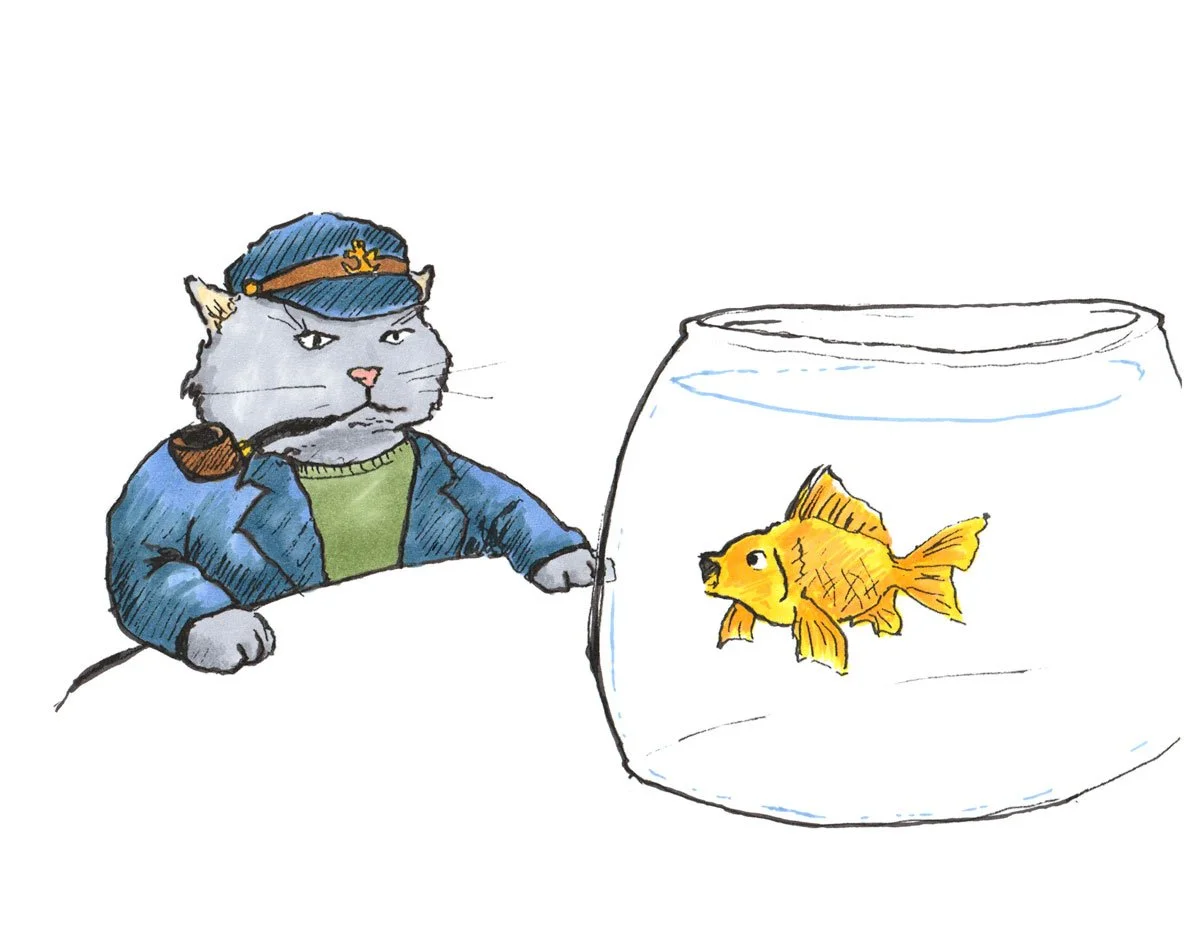
Pen and ink sketch of a cat watching a goldfish
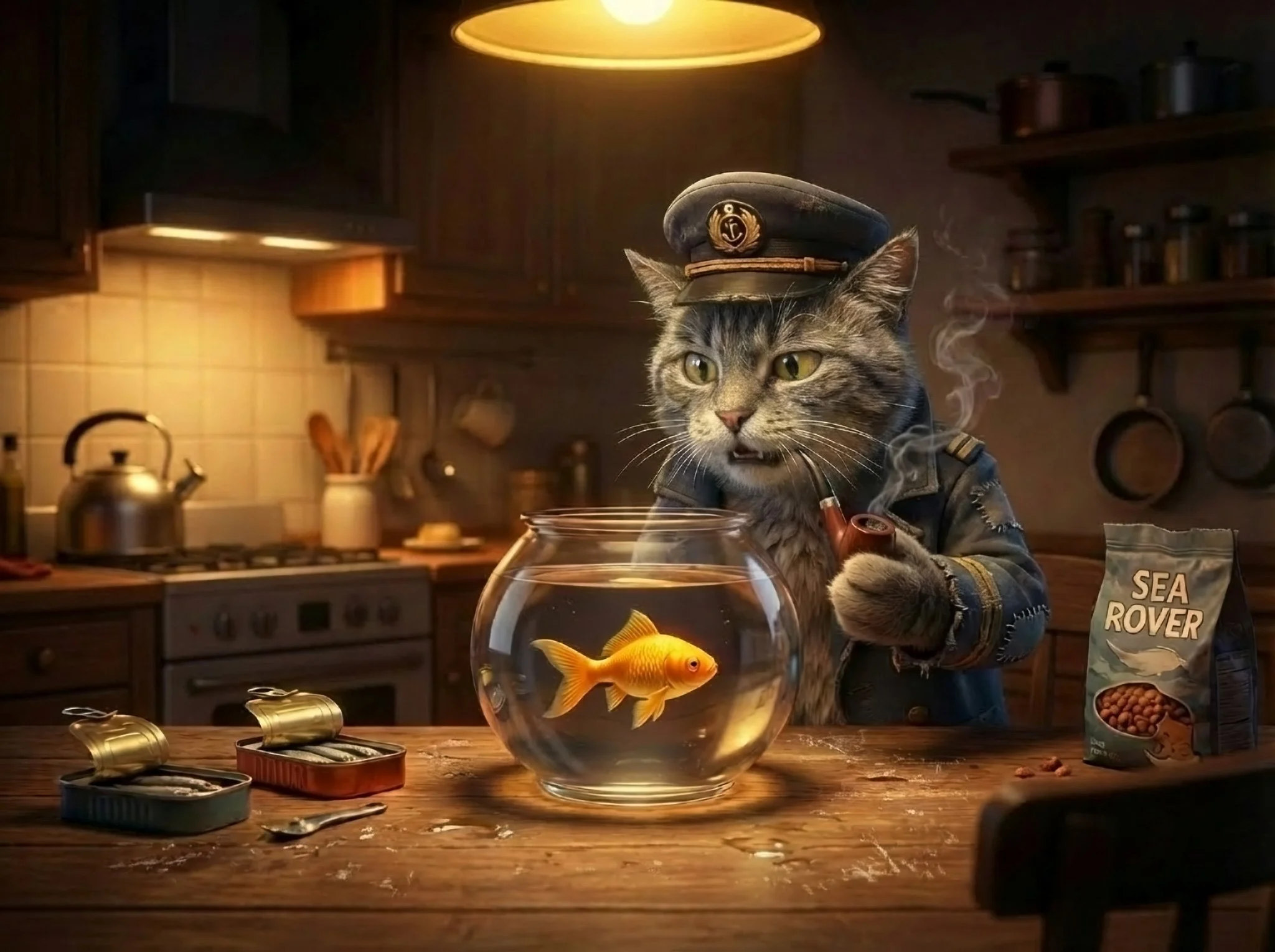
AI generated image of a cat talking to a goldfish
By the end of Adobe’s free trial period, I had a dozen or so fully rendered images that I actually liked. I saw my drawings come to life in a new way. I should have been excited, but instead I felt sad, melancholy even. All that power to make stunning images and yet it feels like something unnameable has been lost. I ended the weekend with more questions than answers. I wonder about my role as an artist given the power of these new tools. And I wonder if I'm really being more of an art director than an artist when I use AI.
Over the years, other people have directed me to edit and enhance photos in Adobe Photoshop for publications, email newsletters, marketing materials, and websites. In some cases, another person, usually my boss, has stood over my shoulder and told me how they want it to look. I've gone through that back-and-forth process with a director many times. The director asks me to do the work, makes suggestions, and then directs the outcomes. At times, I have felt like a pair of hands providing the artistic skills while the director tells me what they want. In that case, I'm the designer and someone else is the director. It’s strikingly similar to AI prompting.
Someone who sends an email to a designer may have a vision for the piece, but they're not the artist. They're the director. The process is often collaborative, bouncing ideas off each other and determining what's possible, but ultimately the entity generating the final image is the artist and the person providing instructions is the director.
If I sit down at a keyboard and send a message to an AI, am I the artist or the art director? Am I creating at all or am I simply directing? It seems to me that if I'm not directly working with the materials and I'm only providing instructions, then I'm not really the artist. I'm the art director. Being an art director requires its own unique set of skills and it's hard work, but it's not the same. On the other hand, if I think of AI as new medium for transforming my hand drawn sketches into digital images, then maybe I am being an artist. So the question remains: is AI the artist and I'm the art director or is AI simply a new medium for artistic expression?

AI Generated Art: It took twenty tries and nearly two hours to produce this illustration of a cat dressed as a sea captain, 2025
Joshua Wait is a writer and an artist. He founded Blue Rivers to provide a space for poetry, art, and photography. He is the author of multiple books.