O Night: Finding Solace in Isolation
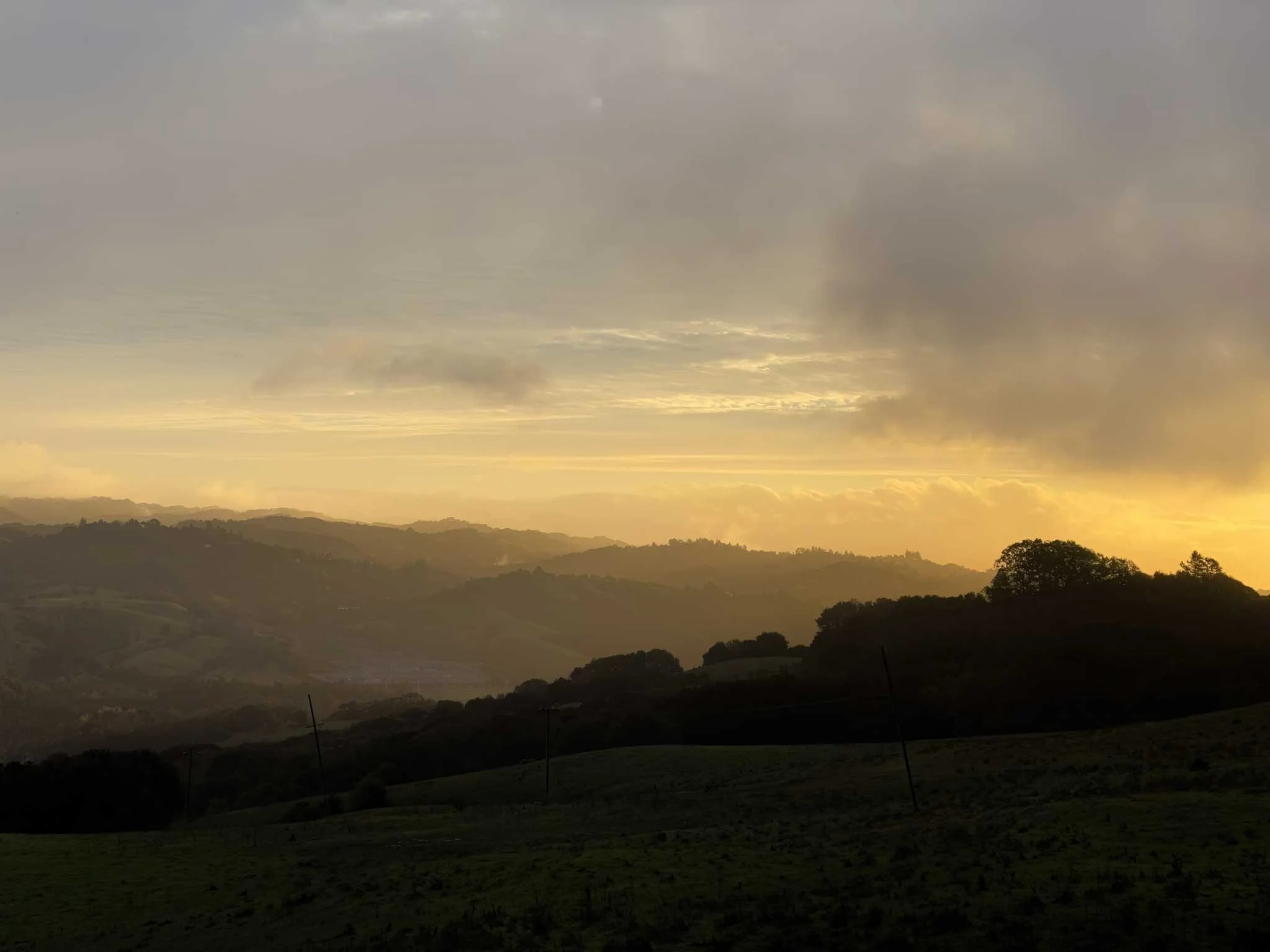
Dawn at Tilden Park, the moment when silence breaks
I drove through the darkness into Berkeley, feeling alone and isolated. The pandemic had been raging for more than a year and I had little contact with my friends. A line from Giuseppe Ungaretti’s poem O notte spoke to me: “E già sono deserto.” In English, “And already I’m desert.” I finally understood the poem—not because I had analyzed it, but because I had lived with it. I felt the words in my body. After that moment, the poem became a companion, traveling with me through hard times. And although the poem is a hundred years old, its words have consoled me, reminding me that others have travelled this road.
Ungaretti wrote the poem in 1919, a year after fighting in the trenches of World War I. During the war, he spent countless hours in the darkness. Battlefields don’t have street lights and it was dangerous to use a light—snipers might see you. In Vita d’un uomo, Ungaretti wrote “all night the soldier remained without sleep and in the darkness his eyes, though open, were without vision, they were silent.”
The poem begins at dawn—the moment when silence breaks. Andrew Frisardi called the first line, “Dall’ampia ansia dell’alba,” mind‑bogglingly beautiful. He translated it as, “Out of daybreak’s huge and restless hunger.” His version conveys the emotion in the poem, but departs from its literal meaning. A more direct translation—“Out of the ample anticipation of the dawn”—is faithful, but wooden.
If we take a close look at the line, we can come to understand it better. Ungaretti uses a technique called assonance. He repeats the “ah” sound to evoke a certain feeling. English speakers would pronounce each ‘a’ slightly differently. The first ‘a’ in ‘alba’ would be deeper like the ‘a’ in father and the last one would be more like the ‘a’ in about. Italians, however, would pronounce each ‘a’ the same. It’s not the short sharp ‘a’ in cat and it’s not the long resonant ‘a’ in father. It’s closer to the ‘a’ car. The repetition of this sound causes us to feel a vibrating moment in our mouths and experience anticipation in our bodies.
The second line, “Svelata alberatura,” contains only two words. Frisardi translates it as “Trees—like masts—revealed.” Alberatura can mean masts or it can mean cultivated trees like cypress. The poem doesn’t suggest a maritime setting to me. When I imagine the scene, I see a line of dark trees on a hill at dawn. Even so, the double meaning—trees as masts—makes the image richer.
The next stanza offers another pair of words: “Dolorosi risvegli,” or “Anguished awakenings.” Dawn often brings relief after a sleepless night, yet here it carries the weight of what resurfaces in the light of day.
Next, Ungaretti writes, “Leaves, sister leaves, / I hear your lament.” The image recalls his poem “Soldiers,” where falling leaves represent falling soldiers in combat. In O notte, the focus shifts to the suffering of women—sister leaves—who feel the pull of gravity in the autumn of life.
The poem then moves from the autumn of life to the towering skies of youth. I remember being in my twenties. The future opened to me like a vast sky. The possibilities seemed limitless. I felt an unbridled flow of creative energy. Mortality seemed far off. Ungaretti was about thirty when he wrote the poem. He stood at a turning point between youth and middle age. He had witnessed the horrors of war and become conscious of life’s limits.
At this moment he writes, “passed is the hour of detachment.” The Italian distacco can refer to the changing of the guard or a detachment of soldiers. In 1916, he wrote a poem called “Distacco” where he says, “Behold a uniform/a man/behold a desert/soul.” He equates the soldier’s uniform with the man and the desert with the soul. Fulfilling our duty can leave us feeling barren inside like a desert. In O notte, he doesn’t say, “I’m in the desert,” he says “I am desert.” Being in the desert is living with it’s barrenness, but being the desert is to feel barren.
He continues, “I am lost in this melancholy curve.” The first time I read this line, I felt it deeply and personally. For many, the pandemic was a a time of isolation and melancholy. Though Ungaretti’s experience differs—separated by time, language, and culture—his words resonate with my experience.
The poem reaches its crescendo at this moment. The final three stanzas return to night. Ungaretti writes, “But the night disperses the separations.” He contrasts the energy of day and the ambition of youth with the silence of night and the bittersweetness of mortality. The towering skies of youth become what he calls “Oceanic silences.”
At the beach, I can stand on the shore, hear the ocean, smell the breeze, and feel the rhythm of waves. Looking up at the stars, they gleam like light on the water—but they are silent. Their distance both comforts and troubles. After wrestling with painful awakenings, interior deserts, and oceanic silences, Ungaretti concludes simply: “O night.”
Joshua Wait is a writer and an artist. He founded Blue Rivers to provide a space for poetry, art, and photography. He is the author of multiple books.